Energy Moves in Springfield, Illinois’ Record Year in Solar, and Changing Building Emission Trends | Illinois Green Policy Update: March 2025
We have good news to share out of Evanston, from around the state, and even across the globe! In the March Policy Update, we'll be celebrating Evanston's big green building policy win, spotlighting building efficiency proposals in Springfield, looking at Illinois' record year for solar, and more!
First in the State – Twice!
Congratulations to the City of Evanston on being the first Illinois community to pass two major green building policies—the
Stretch Energy Codes and
Healthy Buildings Ordinance! Around 80% of Evanston’s emissions come from the building sector, making this a key step in the effort to address climate change and we hope that communities across the state follow your lead (more on this below)!
I also want to thank the many Illinois Green members who were an incredible help getting these ordinances passed by sharing their expertise with council members.
And that's not all to celebrate! Evanston's Green Homes Pilot Program, which provides free, income-qualified weatherization and electrification upgrades, is starting to deliver these projects to residents!
Interested in helping Evanston create the rules to put the Healthy Buildings Ordinance into action? Contact Ryan Wilmington to learn how you can lend your expertise. Also, learn about one of the pathways to comply with the Stretch Code at our upcoming Phius 101 webinar.
Springfield Sessions
Over 6,000(!) bills have been introduced to the Illinois State Legislature this year – we’re tracking a few of these focused on green buildings.
Here are some key proposals that building professionals should be aware of:
- Legislators and advocates are looking to follow up Illinois’ nation-leading climate legislation, the 2021 Climate and Equitable Jobs Act (CEJA), with a major effort to support transmission and efficiency. The
Clean and Reliable Grid Act would expand utility efficiency incentive programs and cut the red tape that slows or stops new clean energy projects.
Read more here.
- There’s a lot of buzz around thermal energy this session, too! Now that early adopters like the University of Illinois Urbana-Champaign and
Blacks in Green are demonstrating its potential, policymakers are looking to support this technology. The
Thermal Energy Network Act would require public utilities in the state to develop geothermal pilot projects and the Geothermal Homes and Business Act would make geothermal renewable energy credits available.
- A push to make building energy data and incentives easier to access is also in the works. The Utility Data Access Act would allow multi-unit building owners to access whole-building data to make it easier to understand how their building is performing, and the State Navigator Program Act would create a permanent program to help Illinois residents easily plan and access incentives and financing for home upgrades that can help lower energy costs.
As this year’s legislative session continues, we’ll keep track of these bills and inform green professionals of any opportunities to weigh in and share why these efforts will help meet our climate goals and benefit the building industry in Illinois.
Get news and policy alerts by email! Sign up for our new newsletter!
The new Illinois Green Policy Newsletter will bring this monthly update, feature stories and timely advocacy action alerts directly to your inbox. Sign up to stay up to date on the latest local sustainability policy news and the ways you as a building professional can use your expertise make a difference.
A Ray of Sunshine – Illinois Breaks Solar Record
In 2024, Illinois installed 2.5 GIGAWATTS of solar power—the most by the state in a single year!
To put this in perspective:
- The new installation almost DOUBLES our solar capacity
- Solar now generates enough energy to power 930,000 homes
- Illinois now maintains 5% of all solar installed NATIONWIDE
- Only sunny states like California, Florida, and Texas installed more
This growth is more evidence that Illinois’ nation-leading climate legislation, the 2017 Future Energy Jobs Act (FEJA) and CEJA, are working. In the years since FEJA was passed, Illinois added over 3,500 MegaWatts of solar to the grid (not including this year’s 2.5 GW). Before 2017, we only had 80 MW of solar in the entire state.
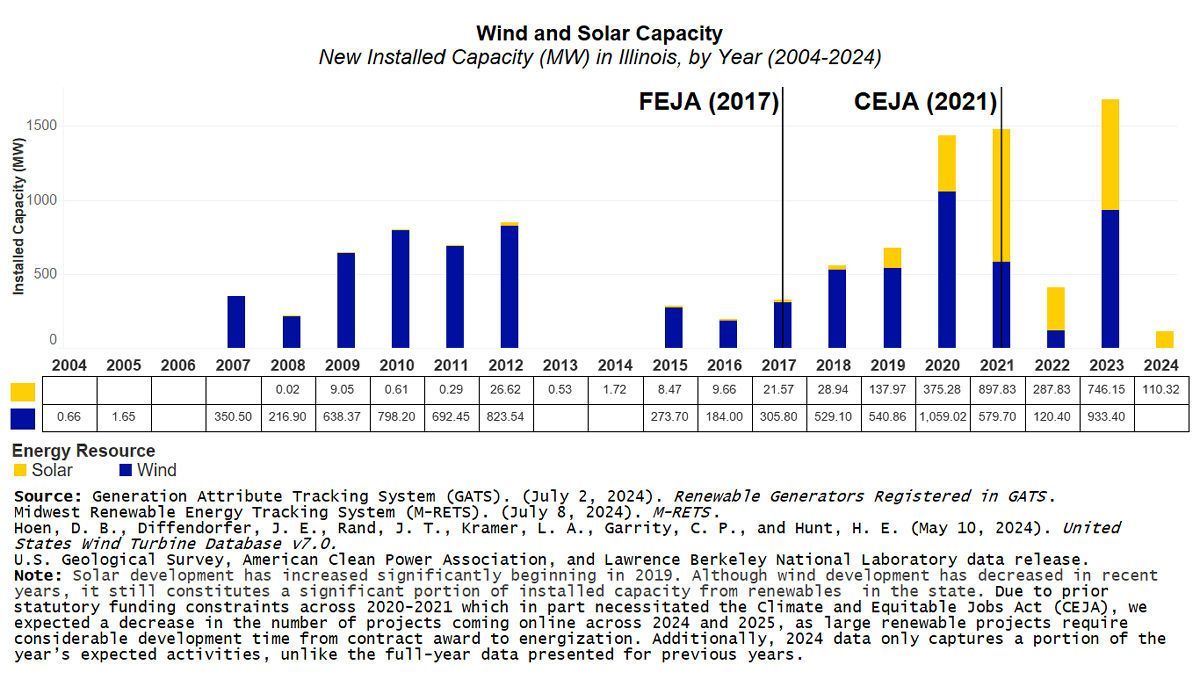
Key initiatives like incentives and credits, community solar efforts, and the Illinois Solar for All program contributed to this record-breaking year.
Now, with Governor Pritzker recently announcing over $57 million more in CEJA grant awards for green energy and efficiency projects, more solar will be added to the gird soon. And if the legislature passes the Clean and Reliable Grid Act (mentioned earlier), this energy transition could get even faster.
Read more here - Chicago Tribune
Zooming Out – Global Building Sector Emissions Stop Rising
In 2023, the building industry grew, but the sector’s emissions didn’t—showing that green technologies and policies are making a difference, according to a UN report.
Why is this a big deal?
The building sector is the source of 34% of global emissions and this number has been trending upwards in recent years.
How is this happening?
According to the report, key policies like advanced energy codes, performance standards, and efficiency investments are driving the progress. These policies, combined with private sector sustainability initiatives, have reduced the building sector’s energy intensity by 10%!
And the most important question for us—what does this mean for Illinois?
Illinois’ buildings contribute to 30% of our state’s greenhouse gas emissions, which means that addressing this sector will be key to meeting climate goals—and this report demonstrates a proven policy pathway for accomplishing that. Now that Evanston has adopted the Illinois Stretch Energy Codes and Healthy Buildings Ordinance (Building Performance Standards), we now also have a local model for taking on building emissions. If other cities replicate Evanston’s actions, Illinois would make incredible progress and do our part in addressing climate change.
Read more here -
UN Environment Programme
In Other Sustainability News
A Business Guide for Navigating IRA Clean-Energy Tax Credits
Read more – Sustainable Brands
Time-based rates convince Chicago-area residents to shift electricity use
Read more – Canary Media
Utility energy efficiency investment hit record $8.8B in 2023: ACEEE
Read more - Utility Dive
Federal judge blocks EPA’s $14B GGRF funding freeze
Read more – Utility Dive
Chicago community group advances EVs, despite federal setbacks
Read more –
Canary Media